Contents
2. Procedure and control description
The supply forms the system boundary and is also the interface to the upstream process, which is not part of the model.
2. Procedure and control description
The Supply element as a system boundary can be used in different ways in the model.
For example, the primary material flow (main flow) such as for products, containers, bottles, etc. or secondary material flows (secondary flows) for packaging materials such as cardboard blanks for collective packaging, caps, labels, products, etc. can be modeled with the Supply.
The material is fed continuously without interruption as a constant material flow (no cycle time fluctuations) with the set cycle time.
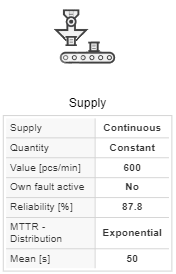
The Supply performance (cycle time value) and a failure behaviour (availability and MTTR) can be parameterized for the Supply. In the default setting, the failure behavior is deactivated.
Figure 1 shows different variants of the feed.
|
Main stream feed Cylinders on pallet |
|
Secondary stream feed Product |
|
Secondary stream feed Caps |
|
Secondary stream feed Labels |
|
Secondary stream feed Blanks |


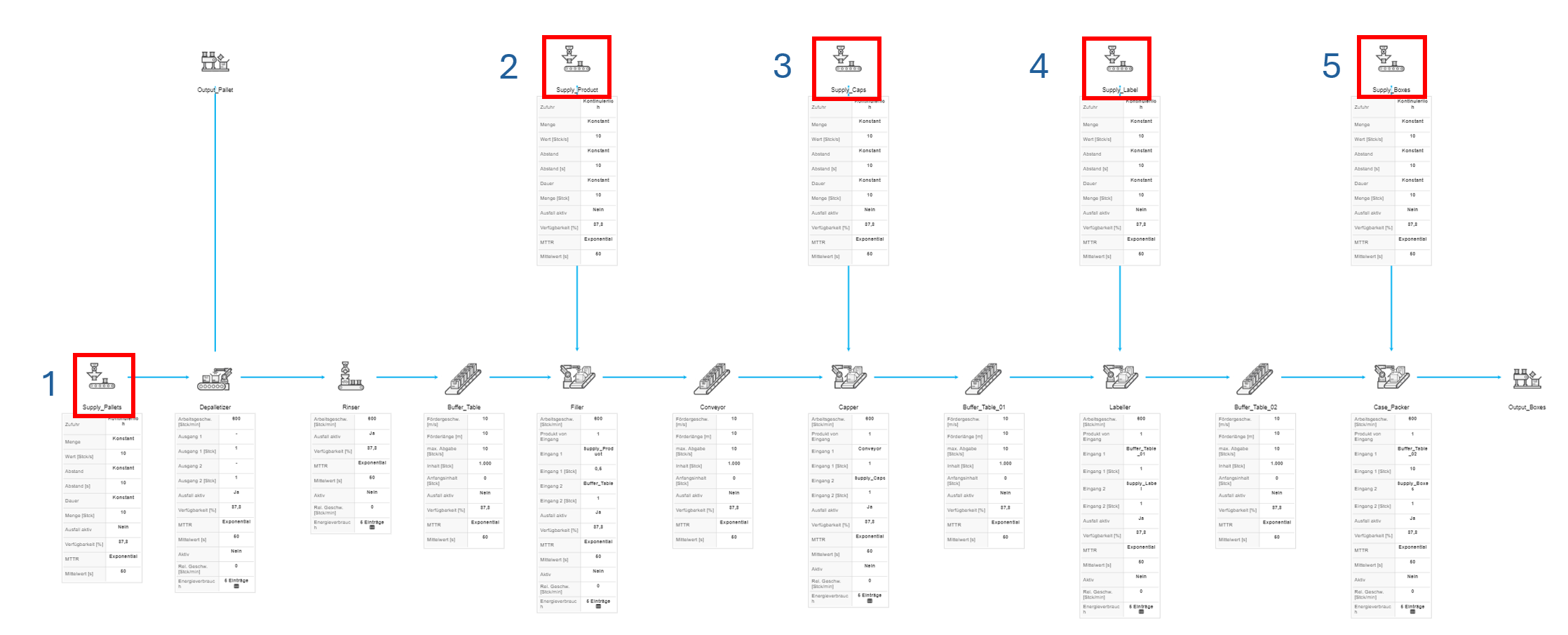
Figure 1 - Feed variants
Figure 2 - Supply |
|
© SimPlan AG - Hanau District Court, Commercial Register (Part B) 6845 - info@simplan.de - www.simplan.de/en