Contents
2. Procedure and control description
The conveyor transports the products along the belt at the specified speed. When the conveyor stops, the distance between the products on the conveyor belt is maintained.
2. Procedure and control description
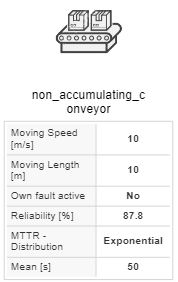
The non accumulatiing conveyor element is described as a conveyor belt. Accordingly, a conveyor speed and a conveyor length can be parameterized. Conveyor belts can only run in the feed direction, never backwards.
A failure behaviour (availability and MTTR) can also be parameterized for the non accumulatiing conveyor. The failure behavior is deactivated by default.
The conveyor stops immediately if the output is blocked, regardless of the content. Objects (products) on the belt cannot move up and close any gaps (see also accumulatiing conveyor).
The loading of the belt (number of objects on the belt) is determined by the cycle time of the upstream element, the length and speed of the conveyor belt and the cycle time of the downstream element.
The dimensioning of the products does not play a role in the simulation. Alternatively, the maximum loading of the conveyor belt with products depending on their dimensions for the parameters conveyor length and conveyor speed must be determined manually and then adopted.
Figure 2 - non accumulating conveyor |
|
© SimPlan AG - Hanau District Court, Commercial Register (Part B) 6845 - info@simplan.de - www.simplan.de/en